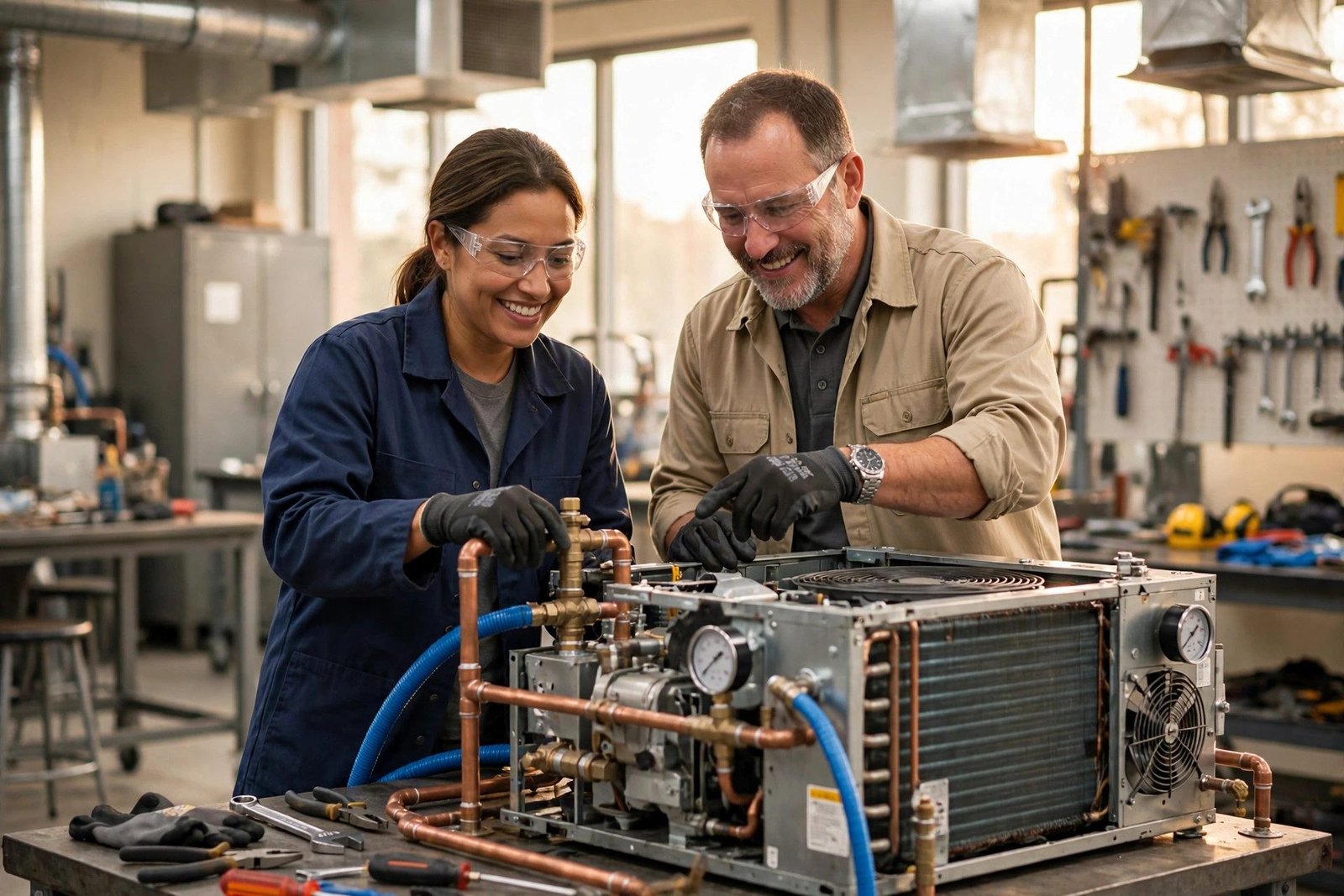
For fifty years, a Pell Grant — the federal grant that helps lower-income students pay for college, and never has to be paid back — only worked for degree programs and long courses. That changed on July 1, 2026. Under a new program called Workforce Pell, Pell money can now pay for short job training: programs as short as 8 weeks that train you for a specific job, like phlebotomy, welding, or HVAC.
Here is the honest picture before anything else: the program is real and the money exists, but it is brand new, and approvals are rolling out college by college. As of October 2026, five Texas colleges have programs approved by the U.S. Department of Education — and none of them is in San Antonio yet. This guide tells you exactly what’s approved, who qualifies, what to do if you’re in San Antonio, and the exact steps to apply.
What Workforce Pell is
Workforce Pell is part of the regular federal Pell Grant program, created by the Working Families Tax Cuts Act in 2025 and opened for students on July 1, 2026. It points Pell money at short, career-focused training instead of degrees.
A program can only offer Workforce Pell if it meets strict federal rules:
- 150 to 599 hours of instruction, lasting at least 8 weeks but less than 15 weeks
- It leads to a recognized credential (a certificate, license, or similar) that can stack toward more education later
- It trains for high-skill, high-wage, or in-demand jobs
- It has already been running for at least a year — brand-new courses can’t qualify
- It is offered by an accredited college that already handles federal student aid
- It was certified by the state (in Texas, through the state process overseen by the Governor with the Texas Workforce Commission and the Texas Higher Education Coordinating Board) and approved by the U.S. Department of Education
Approval is program by program, not college-wide. A college can have one approved program and ten that aren’t. Always ask about the exact program you want.
Who qualifies — in plain words
You may qualify for Workforce Pell if:
- You complete the FAFSA (the free federal aid form — steps below) and it shows financial need, the same way regular Pell works. The FAFSA calculates a number called your Student Aid Index; lower income generally means a bigger grant.
- You have a high school diploma, a GED, or an equivalent.
- You are a U.S. citizen or an eligible noncitizen with a valid Social Security number.
- You enroll in a program that is approved for Workforce Pell (the Texas list is below).
Three things surprise people:
- Already have a bachelor’s degree? You can still qualify. Regular Pell shuts off after a bachelor’s — Workforce Pell is the exception, built for career changers. (If you hold a graduate degree — a master’s or doctorate — you don’t qualify.)
- You can’t collect both at once. Workforce Pell and a regular Pell Grant can’t be paid for the same enrollment.
- It counts toward your lifetime Pell limit. Pell eligibility lasts the equivalent of 12 semesters over your lifetime. A short program uses a small slice of it — worth knowing if you may want a degree later.
How much money is it? The full Pell maximum for 2026–27 is $7,395. Workforce Pell awards are prorated — you get a portion based on how long the program is, so an 8-week program gets a smaller slice than a near-15-week one. The college’s financial aid office calculates your exact amount from your FAFSA. And it is a grant: you do not repay it — it’s not a loan.
The 70% numbers are a test for the program — not for you
You may see “70%” figures quoted about Workforce Pell. Those are standards the program must meet to be allowed in at all — a report card for the college, not a hurdle for you:
- At least 70% of a program’s students must finish it.
- At least 70% must be working in the months after they finish.
- A program’s tuition also can’t exceed the extra earnings its graduates gain — colleges can’t charge premium prices for training that doesn’t pay off.
In plain words: the government only lets programs with proven results touch this money.
Approved in Texas right now: 5 colleges, 9 programs
These are the Texas programs the U.S. Department of Education has approved for Workforce Pell (announced September 22, 2026, and listed by the Texas Higher Education Coordinating Board). The fields read like a list of jobs San Antonio employers hire for every week — health care and the trades:
| College | Approved programs | From San Antonio |
|---|---|---|
| Central Texas College (Killeen) | Pharmacy Technician | About a 2½-hour drive |
| San Jacinto College (Pasadena, Houston area) | Phlebotomy Technician | About a 3-hour drive |
| Weatherford College (Weatherford) | HVAC · Basic Machining · Advanced Machining | About a 3½-hour drive |
| Kilgore College (Kilgore) | Electrical Power Lineman · Phlebotomy Technician · Pharmacy Technician | About a 4½-hour drive |
| Texas Southmost College (Brownsville) | Structural Welding (SMAW) | About a 4½-hour drive |
More approvals are expected on a rolling basis — the Department of Education is approving new programs state by state, and Texas officials say more colleges will follow. The fields approved so far in Texas are phlebotomy, pharmacy technology, electrical line work, HVAC, machining, and welding. (Tech fields are coming nationally — an IT support program was approved in Nebraska — but no Texas tech program is on the federal list yet.)
What about San Antonio? The Alamo Colleges news
No Alamo Colleges program is on the federal approved list yet — anyone who tells you otherwise is ahead of the facts. But Alamo is not sitting this out: the Alamo Colleges District is leading a $10.4 million U.S. Department of Labor effort, run from Northwest Vista College, that helps Texas community colleges create and expand exactly these short-term, Workforce-Pell-eligible programs over the next four years — expected to serve about 22,000 students statewide.
So if you’re in San Antonio, do these three things now:
- File your FAFSA today (steps below). When a local program opens, the people who already have a FAFSA on file can move first — don’t let paperwork be the delay.
- Call Alamo Colleges and ask — the Student Contact Center at 210-212-5266 covers financial aid and continuing education. Ask which short-term programs they expect to bring under Workforce Pell and how to hear when they open.
- If you need training now, don’t wait — San Antonio already has free and low-cost job training routes, including WIOA-funded training through Workforce Solutions Alamo (210-272-3260). We rounded them up here: Free Job Training Programs in San Antonio That Lead to Real Paychecks.
How to apply: the exact FAFSA steps, in order
There is no separate Workforce Pell application. You apply with the same FAFSA as every other federal student aid:
- Create your account at StudentAid.gov — this username and password (your FSA ID) is how you sign the form. If you’re a dependent student, a parent may need their own account too.
- Gather your documents: your Social Security number; a driver’s license or state ID if you have one; your federal tax returns; records of any untaxed income; and current bank and investment balances.
- Start the FAFSA at StudentAid.gov (Apply for Aid → FAFSA Form), for the school year when your program starts. Give consent to transfer your IRS tax data into the form — without that consent, you can’t receive federal aid.
- Add the college’s federal school code when the form asks where to send your information. Each college lists its code on its financial aid page — add the code for the college you actually plan to attend, so its aid office receives your results.
- Sign with your FSA ID and submit. You’ll receive a FAFSA Submission Summary — read it and fix any errors right away.
- Call the college’s financial aid office. Confirm the exact program you want is approved for Workforce Pell, ask what your award would cover, and complete any extra paperwork they request (some students are asked to verify information — it’s routine).
- Enroll once the college confirms your aid. The grant is paid to the college toward your tuition and fees.
Need a hand with the form itself? San Antonio has free, in-person FAFSA help — see our guide: Free FAFSA Help in San Antonio. You can also call the Federal Student Aid Information Center at 1-800-433-3243.
Training is only one piece of a household budget. If money is tight while you train, take our 2-minute checker and see what else your family may qualify for: Check what you qualify for → And if you’d like a person to help you sort your options, our free Apply for Me program builds you a personalized guide to the benefits your family may qualify for.
Helpful links & phone numbers
- FAFSA & federal aid: studentaid.gov — Federal Student Aid Information Center: 1-800-433-3243
- U.S. Dept. of Education — Texas approvals (Sept. 22, 2026): ed.gov announcement
- Texas Higher Education Coordinating Board — Workforce Pell (official Texas list): highered.texas.gov — 512-427-6101
- Alamo Colleges Student Contact Center (financial aid & continuing ed): 210-212-5266 — alamo.edu
- Workforce Solutions Alamo (WIOA training help): 210-272-3260
- Texas 2-1-1: dial 2-1-1 for local help of every kind
- San Antonio Benefits eligibility checker: Check what you qualify for
FAQ
Is Workforce Pell really free money?
It’s a grant, not a loan — you don’t repay it. Two honest caveats: the award is prorated by program length, so it may not cover every dollar of cost, and things like tools, uniforms, or licensing exam fees can be extra. Ask the college’s aid office exactly what your award covers before you enroll.
I already have a bachelor’s degree. Am I shut out?
No — that’s the big change. Bachelor’s degree holders can receive Workforce Pell for career-change training. Only graduate-degree holders (master’s, doctorate) are excluded.
Can I use Workforce Pell for any short course near me?
No. Only the specific programs the Department of Education has approved, at the specific colleges approved to offer them. A similar-looking course at another college — even a good one — doesn’t qualify until it’s approved.
When will San Antonio get an approved program?
Nobody has published a date. Approvals are rolling, and Alamo Colleges is leading the statewide effort to build these programs. File your FAFSA now and check the Texas Higher Education Coordinating Board’s list (linked above) — we’ll update this guide as Texas approvals land.
What if I drop out?
Tell the college before you stop attending. Grants don’t have to be repaid when you complete a program, but leaving very early can mean the college has to return part of the money — ask the aid office how it works before it happens, not after.
♥ NEIGHBORS HELPING NEIGHBORS
Thank you for reading. This guide was free. If it helped your family, $3 a month keeps this running for the next family.
$3 a month helps pay for the hosting and the checking that keeps this help free and up to date. $3 a month — chip in.
Gifts are not tax-deductible.
Free food, free rides, free clothes, free furniture and more — all in one place.